
What is a knowledge-based business?
A knowledge-based business is one that earns money from expertise rather than from physical products. You package what you know as courses, coaching, a paid community, a membership or digital products, and sell access to it online. Start-up costs are mostly your time, because there is no stock to buy, and the same lesson or template can be sold many times.
This guide covers the main models, how to choose a topic, and the steps from first idea to first sale.
The main knowledge business models
Most knowledge businesses combine two or three of these:
- Online courses. A structured path to a result, delivered as video, text, quizzes and assignments. Sold once, delivered many times.
- Coaching and consulting. One-to-one or group sessions. The fastest way to earn and to learn what your clients actually struggle with.
- Communities and memberships. A recurring subscription for ongoing access to you, to other members and to new content.
- Digital products. Templates, workbooks, checklists, ebooks and recordings sold as downloads.
- Workshops and live events. Paid sessions on one focused topic, often recorded and resold.
Coaches often start with sessions, turn their method into a course, and add a community so students keep going after the course ends.
Step 1: Pick a topic people will pay to learn
A good topic sits where three things overlap: what you know well, what a specific group of people wants, and a result they can describe. "Social media" is too broad. "Getting a first 20 bookings for a new yoga studio from Instagram" is specific enough to sell.
Ways to test a topic before you build:
- list the questions people already ask you
- look at what is selling in your niche and where the reviews say it falls short
- run a short survey with your audience
- offer a small paid workshop and see who signs up
For more starting points, see these online course ideas.
Step 2: Define the outcome and the offer
Write one sentence: "After this, you will be able to …". That outcome shapes everything else: the lessons, the price and the sales page.
Then decide the first offer. A simple ladder works well:
- a free resource that captures an email address
- a low-priced product or workshop
- the core course or group programme
- one-to-one coaching or a membership for the people who want more
You do not need all four at launch. Start with one paid offer and one free way in.
Step 3: Build the first product
If you start with a course, outline modules that move a learner from where they are to the outcome, with a quiz or assignment where they need to practise. The Vonza online course platform supports video, file, text, embed, live-stream, stock-image, quiz and assignment blocks, drip release by date or progress, and completion certificates.
If you already have recordings of talks or sessions, the AI course creator can transcribe them, split them into lessons, write summaries and draft a quiz per module. It uses AI credits, and every draft is yours to edit.
If you start with coaching, set up a booking page so clients can book and pay in one step. With paid appointments in the new Scheduling (you can try it beside classic scheduling), each meeting length can carry its own price, and clients pay when they book.
If you start with digital products, keep the first one small: a template, a checklist or a recorded workshop that solves one problem well. It is quicker to make, easier to price and gives buyers a reason to trust you with a larger purchase later.
Step 4: Price it
Knowledge products are priced on the value of the outcome, not the hours of video. A few principles:
- price the result, not the content length
- offer a payment plan for higher prices so more people can say yes
- raise prices as you collect proof that the outcome is real
Vonza courses support seven price types: free, one-time purchase, subscription, recurring payment, instalment plan, flexible payment and pay what you want, plus coupons and bump offers. Our guide on how to price your course goes into detail.
Step 5: Build an audience and capture leads
A knowledge business grows from trust. Share useful content where your audience already spends time: short videos, posts, a newsletter, podcast guest spots. Every piece should point to one free resource that collects an email address.
A sign-up form or a short quiz works well as that free resource. On Vonza, every respondent who leaves an email becomes a contact in your CRM, tagged automatically, so you know which resource brought them in and what they are interested in.
Once you have the email, follow up. An email sequence that teaches, shares a story and then invites people to the paid offer will do more than a single launch announcement.
Step 6: Sell and deliver
When someone buys, three things should happen without you lifting a finger: payment is taken, access is granted, and a welcome email goes out. On Vonza, buyers pay through your own Stripe or PayPal account (PayPal for one-time payments) or Paystack for Nigerian naira, and automations can enrol each buyer into the course the moment they pay.
Delivery is where the reputation is built. Check in with students, answer questions quickly and collect feedback after each module. Students on Vonza get a portal on your own domain with their progress, a player that resumes where they stopped, quizzes, assignments and certificates behind one login, which removes most "where do I find…" emails.
Feedback is also your product roadmap. The questions students ask in week two tell you which lesson needs a better example, and the requests you hear after the course ends tell you what to build next.
Step 7: Add recurring income
Once a course is selling, look at what students ask for next. Often it is ongoing support and a place to talk to each other. A paid community or a membership turns that into a monthly subscription, with your courses and digital products linked inside it.
Mistakes to avoid
- Building for months before selling. Pre-sell or run a pilot first.
- A topic that is too broad. Specific outcomes sell; general knowledge does not.
- Too many tools. Juggling separate apps for courses, bookings, email and payments costs money and time, and every connection between them is a point that can break.
- No follow-up. Most buyers need several touches before they are ready.
Running it on one platform
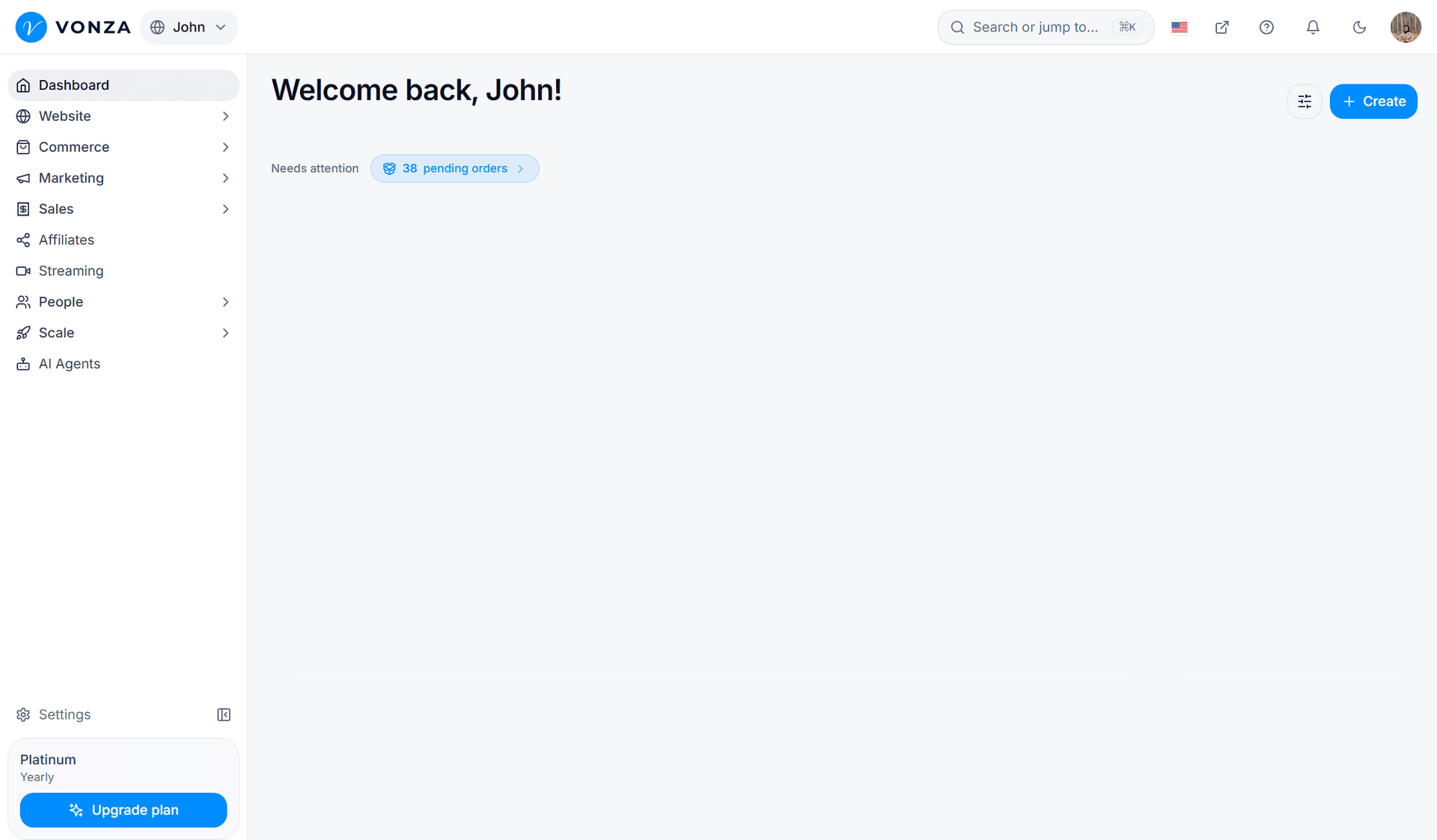
A knowledge business needs a place to host courses, take bookings, sell downloads, run a community, capture leads, send emails and take payments. Vonza puts all of these in one account, so a lead from a form can become a contact, get an email sequence, buy a course and join a community without any connector in between.
It is included in every Vonza plan, 14-day free trial. See pricing for what each plan includes.
Summary
Pick a specific outcome, start with one paid offer, build it quickly, price it on value, and follow up with every lead. Add a community or membership when students ask for more. The knowledge is already yours; the business is the system you build around it.