
To start an email marketing campaign, pick one goal, build a list of people who asked to hear from you, split that list by what they care about, write a short series of emails with one call to action each, test them, send on a schedule, and measure opens, clicks and sales. That is the whole job in one sentence. The eight steps below show how to do each part without overcomplicating it.
An email marketing campaign is a planned series of emails sent to a chosen group of subscribers to reach one goal. A newsletter goes out every week to keep in touch; a campaign has a start, an end and a result you can count, such as course sales, webinar sign-ups or returning customers.
Step 1: Choose one goal
Every campaign needs one goal, written down before you write a single email. Good goals are specific and countable:
- sell places on a course before the doors close;
- fill a free webinar or workshop;
- welcome new subscribers and get them to a first purchase;
- bring back customers who have not bought in six months;
- announce a new product to past buyers.
One goal keeps every email pointed in the same direction. A campaign that tries to sell, educate and ask for reviews at once does none of them well.
Step 2: Build a list of people who opted in
Your list is the people who said yes to your emails. Never buy a list: people who did not sign up mark you as spam, and spam complaints hurt the delivery of everything you send afterwards.
The steady way to grow a list is a sign-up form with a reason to join. Offer something useful in return, such as a checklist, a short guide, a free lesson or a discount, and place the form where interested people already are: your website, your blog posts, your link in bio and the end of your videos.
On Vonza, sign-up forms add subscribers to your list automatically, and every respondent who leaves an email on a Vonza form becomes a CRM contact, tagged as you choose. The lead generation forms page shows the form side, and landing pages give a lead magnet a page of its own.
Step 3: Segment the list
Not everyone on your list wants the same thing. Sending the same email to all of them gets you average results. Split the list into groups that make sense for your goal:
- by interest, such as the lead magnet they downloaded or the topic they clicked;
- by stage, such as new subscribers, past buyers and customers who bought this month;
- by behaviour, such as people who opened recent emails and people who have not.
Tags make this easy. In Vonza's CRM, contacts can be tagged and segmented as they engage, and you can send to your whole list or to one segment.
Step 4: Plan the sequence
Most campaigns are three to five emails. A simple launch sequence looks like this:
- Announcement. What it is, who it is for, and the deadline.
- Value. A useful lesson, story or example that shows the problem you solve.
- Proof and questions. Answer the objections people raise, and explain what is included.
- Reminder. The offer, restated simply, with the date.
- Last call. Short, on the final day.
A welcome sequence for new subscribers follows a similar rhythm over the first one to two weeks: deliver what they signed up for, introduce yourself, share your best content, then make a first offer.
Write the plan down with dates before you write the emails. It keeps the campaign on schedule and stops you sending three emails in one day by accident.
Decide too what happens to people who act early. Someone who buys after the first email should stop getting sales emails and start getting a welcome instead. Someone who clicks but does not buy may deserve one extra, more personal email. Planning these branches up front is what turns a batch of emails into a campaign that feels personal.
Step 5: Write emails people want to open
Each email needs four things.
- A subject line that makes a promise. Be specific and short. "Your 5-step launch checklist" beats "Newsletter #12".
- One idea. Say one thing well. If you have three ideas, you have three emails.
- One call to action. One button or link, written as an action: "Save my seat", "Start the free lesson", "Book a call".
- A human voice. Write as you speak, from a real name, to one reader.
Keep the design simple and mobile-friendly; most email is read on a phone. Vonza lets you create professional, mobile-friendly emails without coding, from templates you can customise and personalise.
Step 6: Test before you send
Send a test to yourself and one other person. Check:
- the subject line and the preview text;
- that every link goes where it should;
- the email on a phone and on a computer;
- names and other personal details fill in correctly;
- the unsubscribe link is present and works.
A short test catches the broken link that would otherwise go to your whole list.
Step 7: Send on a schedule, and automate what repeats
Send at a steady pace. Daily emails for a short launch window are fine; daily emails for months are not. For a regular newsletter, once a week or once a fortnight is a sustainable rhythm.
Anything that should happen every time a person does something is better automated than sent by hand. A welcome sequence should start when someone joins the list; a thank-you and next step should go out after a purchase. With Vonza automations, a form fill, an enrolment, a purchase or a booking can start an email sequence on its own, sent at the interval, on the days and at the time you set.
Step 8: Measure, then improve the next one
Look at the numbers a few days after each email and again at the end of the campaign:
- Opens tell you whether the subject line and sender worked.
- Clicks tell you whether the email itself worked.
- Conversions and revenue tell you whether the campaign reached its goal.
- Unsubscribes and spam complaints tell you whether you sent too much, or to the wrong people.
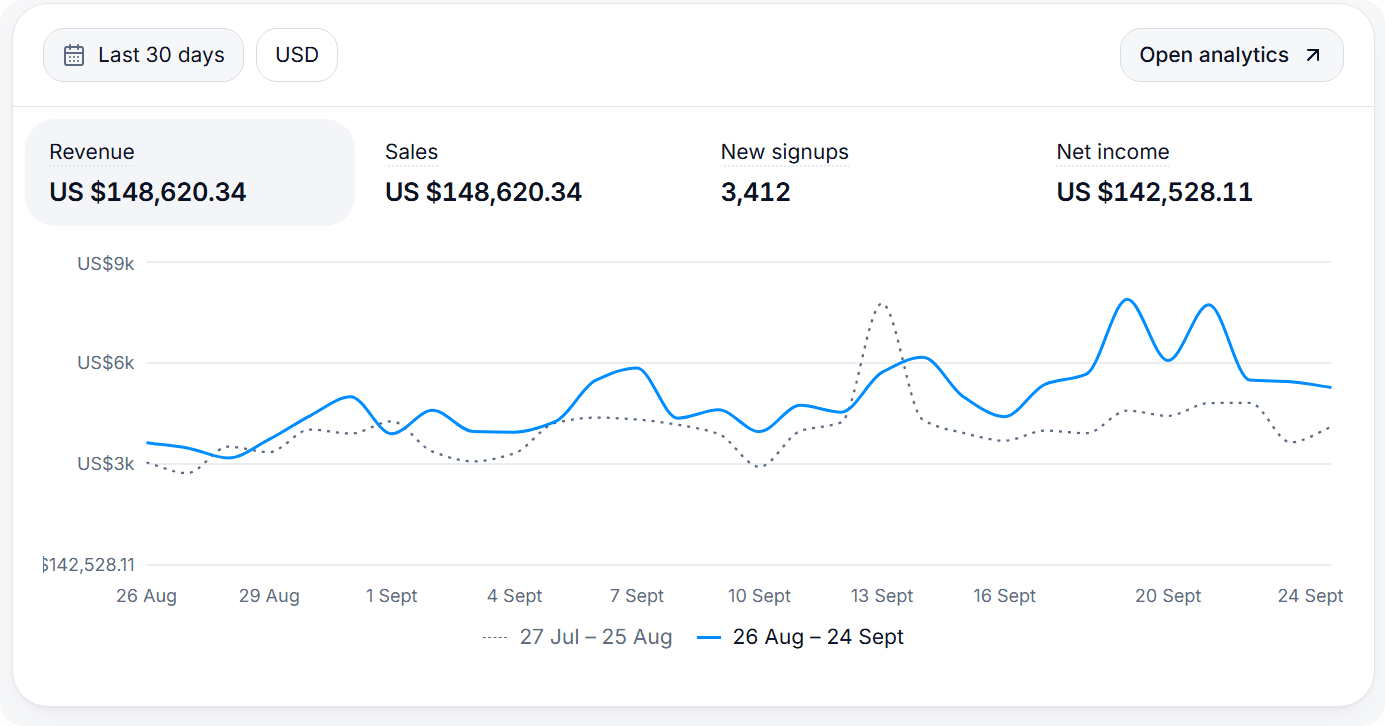
Vonza's email marketing tools track opens, clicks, conversions and revenue in real time. Change one thing at a time between campaigns, such as the subject line style, the send day or the length, so you know what made the difference.
Mistakes to avoid
- No clear goal. If you cannot say what success looks like, you cannot measure it.
- Bought or scraped lists. They damage your delivery for every later email.
- Sending everything to everyone. Segments get better results with fewer complaints.
- Too many calls to action. One per email.
- Never cleaning the list. People who have not opened anything for months drag down your results; send them a last check-in, then remove them.
Start your first campaign
Pick one goal, add a sign-up form, write three to five emails and measure what happens. Vonza puts the forms, the list, the CRM, the emails, the automations and the reports in one account, so a campaign does not need five tools stitched together. Try it with a 14-day free trial.